
From Stephen Rae in Frankfurt
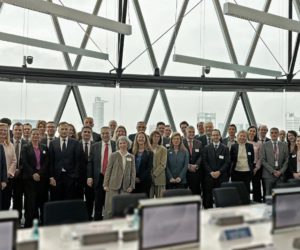
It’s been a busy week Frankfurt where 11,500 bankers gathered at Sibos for the annual conference organised by Swift.
There was an upbeat atmosphere in the exhibition halls and some of the big banks even flew in their own baristas! (Visa had the best coffee from their NYC based beans expert).It was notable that AFC and fraud were themes that ran thru the four days of the conference.
We heard that online fraud alone will cost $70 billion in the US by 2027. Focusing on the end payee was a big theme in all the anti-fraud talks. Speaking of which we report on news from the European Central Bank’s choice for such a model around the digital euro, below.
The event was in the shadow of AMLA headquarters in the pencil-shaped Messeturm building. Up close it’s not as impressive as the publicity shots – and it’s fair to say the small and flat out AMLA team don’t have the best choice of coffee shops or eateries nearby. I hope the choices within the building are good.
Indeed, the site visit underscored what I’ve heard from others: Frankfurt was probably not the best choice as host city. AMLA is under enormous pressure to hire top talent but is up against the powerful European Central Bank and Europe’s top banks which are all based here. Plus the city is not the most attractive, imo. Maybe there’s an argument to be made for satellite offices in two of the other competing cities – such as Madrid, Dublin, Riga or Vilnius?
After all if the Germans themselves are doing it with their FIU (Cologne and Dresden), maybe AMLA should follow!! Let’s try to convince the European Parliament at the AML Intelligence ‘Compliance Council’ roundtable in the parliament in Brussels on November 19!!
As mentioned above, there was other big news out of Frankfurt this week. The European Central Bank picked a Portuguese start up, Feedzai (with Pwc) to win its massive anti-fraud project – worth up to €237 million – around the digital euro. Many of the top AFC companies who splurged on exhibition stands at Sibos must be wondering how they lost out , the full story underneath.
In the meantime, see you at ‘International Anti-Financial Crime Summit 2025’ in London on October 22 which is set to be unmissable with Derville Rowland from AMLA, Kristine Černaja-Mežmale from the Central Bank of Latvia (who have a great story to tell) as well newly announced speakers from across the banking, fintech and crypto sector. Indeed, AMLA is set to speak about their plans around crypto at the event.
Feedzai frenzy
The European Central Bank has picked a Portuguese startup focused on AI to help prevent fraud in its planned digital euro currency.
The contract with Feedzai, worth up to €237.3 million, is one of several announced by the ECB on Thursday to advance a project that it sees as key for the euro zone’s financial autonomy from the US.
Under it, Feedzai and its subcontractor PwC will provide an AI model for scoring digital euro payments by their fraud risk, based on any deviation from a customer’s typical behaviour, interactions and history.
This is aimed at helping payment service providers decide whether to approve a transaction in digital euros, essentially an exchange between electronic wallets backed by the central bank.
The four-year agreement, with an option to extend it to 15 years, has an estimated value of €79.1 million and a cap at €237.3 million.
Four further digital euro contracts worth between €27.6 million and €220.7 million euros were awarded to other companies, including French IT consulting firm Capgemini .
Under such framework agreements, the ECB won’t pay contractors until the project starts.
The central bank is still awaiting legislative approval for its digital euro, which it has pitched as a response to Visa and Mastercard’s dominance and to U.S. President Donald Trump’s promotion of stablecoins pegged to the dollar.
Registered in Portugal, Feedzai says it processes $8 trillion worth of payments every year for clients including Portuguese bank Novobanco and Abu Dhabi’s Wio Bank. On Thursday, it also announced $75 million in funding from Lince Capital, Iberis Capital and Explorer Investments among others.
DEBANKING: US regulators have ordered banks to search for any instances of ‘debanking’ amid a Trump-directed clampdown on the issue.
Lenders have until December 5 to look back over four years worth of records to identify conservatives denied services for religious or political reasons.
The review comes from the Small Business Administration (SBA), which has instructed lenders to offer those customers the option to reopen accounts and re-engage with rejected applicants.
The letter warned that unlawful debanking could lead to referral “to the U.S. Attorney General for appropriate civil action”.
The Office of the Comptroller of the Currency has also asked the nine largest banks it supervises for records covering several years. It said the move aimed to “end the weaponization of the financial system.”
IAFCS2025: Top names for the worlds of FCC in banking and fintech have joined the line-up for ‘International Anti-Financial Crime Summit 2025’ in London on October 22 next.
Jaap van der Molen is Head of the Detecting Financial Crime (DFC) unit at ABN AMRO Bank N.V. The Unit is ABN AMRO Bank’s hashtag 1LOD centre of excellence for financial crime risk management. The DFC unit maintains and executes the standards, systems and operations for all financial crime risk management processes.
Eamon Howard is Revolut’s Group Head of Financial Crime Compliance. Eamon is responsible for monitoring and overseeing Revolut’s financial crime controls and operations, which apply across 65 million customers and 38 countries.
Revolut operates an increasingly complex set of products, onboarding over 1 million customers a month. The fintech invests significantly in combating financial crime, with some 4,000 people working in financial crime departments and the organisation building bespoke, in-house financial crime solutions.
They join the line up of speakers which include AMLA’s Executive Board member Derville Rowland the Kristine Dernaja-Mezmale, Council member of Latvia’s Central Bank.
The program includes sessions on AI, Crypto, PPPs and Regulation. Is your organisation and FCC department represented? Don’t miss out! Registration is now open HERE
BENEFICIAL OWNERSHIP
TRANSPARENCY: A lack of transparency around beneficial ownership data is helping criminals, Moody’s has told EU governments.
The company issued the warning as the European Commission recently issued formal notices to 11 Member States for missing a July 10 deadline to implement public access to beneficial ownership registers.
Francis Marinier, ICA, CAMS , Director of Financial Crime Prevention at Moody’s, said the measure is crucial to fight financial crime.
LAWYERS
UK: The Law Society has warned that UK government plans to amend AML rules for pooled client accounts (PCAs) will create “significant and uncertain compliance burdens” for law firms.
In its response to a Treasury consultation on draft Money Laundering and Terrorist Financing Regulations 2025, the society said the changes could have “serious unintended consequences” for the legal profession.
US SHUTDOWN AFFECTS AGENCIES
FINCEN: FinCEN, the AML unit of the U.S. Department of the Treasury, has outlined its plan to operate during the government shutdown.
The organisation said it will cut back on ‘non-time-sensitive BSA [Bank Secrecy Act] compliance investigations and enforcement actions’, as it operates with reduced staff.
SEC: U.S. market regulators began the process of furloughing workers as the federal government shut down after Congress failed to extend funding.
The shutdown will force the Securities and Exchange Commission (SEC) to furlough more than 90% of its workforce. It will retain only about 393 employees to handle emergency enforcement actions and market surveillance.
CANADA’S SCREENING RULES ON BO
SCREENING: Canada has introduced new screening rules around its beneficial ownership register, which are effective from October 1, 2025.
From now on, whenever a financial institution does business with a company it deems as posing a ‘high’ money laundering risk, they must consult the beneficial ownership register to screen for any issues.