



By CARLO BOFFA, EU Correspondent
Fraud and cryptocurrencies pose the biggest threats to the integrity of the EU’s financial system, according to a survey by Europe’s first public-private financial intelligence initiative.
The Europol Financial Intelligence Public-Private Partnership (EFIPPP) runs the “Threat Radar”annual survey to identify the biggest risks facing European countries, helping regulators and national authorities compile their own national risk assessments.
More than 40% of respondents ranked fraud as the top threat among predicate offences, ahead of drug trafficking and organised crime. The share more than doubled from last year’s survey. The Financial Action Task Force has estimated that fraud costs the global economy about $500 billion.
Cryptocurrencies were named by 38% of respondents as the sector most at risk of money laundering and terrorism financing. It was the first year the survey offered virtual assets as an option.
Respondents cited lack of transparency as the main concern. Criminals often use tumblers and mixers that pool assets from multiple holders and redistribute them randomly, cutting the money trail. Experts also flagged privacy coins and stablecoins as high-risk tools.
Banking remains the highest-risk sector for 34% of respondents, up about a quarter from last year. They pointed to remote onboarding, mobile banking and virtual IBANs as technologies that help criminals cover their tracks. Correspondent banking and cross-border payments also featured among the reasons.
Global threats on the rise
Armed conflicts and growing tension between global powers, which is fragmenting the world into rival blocs, are creating new opportunities for financial crime and sanctions evasion, the survey said.
Respondents also cited a boom in cybercrime, increasingly sophisticated criminal groups and regulatory arbitrage between jurisdictions. They identified Russia and certain countries in the Middle East as the leading threat hotspots.
Risk in neighbouring countries remains high but stable. Fraud, tax evasion, money laundering, smuggling and cash movements are recurring concerns, while sanctions evasion is particularly relevant in Eastern Europe because of its proximity to Russia and Belarus.
Criminals are deploying artificial intelligence and new technologies faster than anti-financial crime teams, helping them become more sophisticated, EFIPPP said.
“The challenge is the rapid transformation and convergence of existing threats, creating a gap between criminal innovation and the response of controls, regulation and law enforcement,” it said.
The body also noted growing convergence between financial and organised crime, with links across fraud, cybercrime, trafficking, exploitation, drug crime and illicit finance.
Respondents said terrorism financing is shifting towards decentralised channels, low-value transfers and sophisticated methods that reduce visibility and overlap with broader criminality. Terrorists increasingly use messaging apps such as WhatsApp and Telegram channels, as well as hawalas, to organise low-value transfers that often escape law enforcement’s attention.
About the survey
EFIPPP is the only transnational initiative of its kind in Europe, with more than 100 members and observers from EU and non-EU countries. They include Europol, the European Commission, AMLA, national financial intelligence units (FIUs), law enforcement agencies, banks and industry associations.
“EFIPPP members have committed themselves that you cannot be a member of EFIPPP if this survey is not at a minimum, is contributed too and filled in,” Theo Strijker, chair of the EUROPOL EFIPPP Threat & Typology working group said.
Strijker said the survey was created as an input into the partnership’s threat and typology work so that it could be replicated and trends identified relatively easily over time.
The survey also aims to inform the European Commission’s Union-level risk assessment, due by July 2028, and to help regulators and the private sector apply a risk-based approach by identifying areas that need greater attention.
This is the survey’s fifth edition. It uses an expert-based methodology built on ranking questions and some open questions. Its scope and number of participants remain relatively limited so that it can run every year.
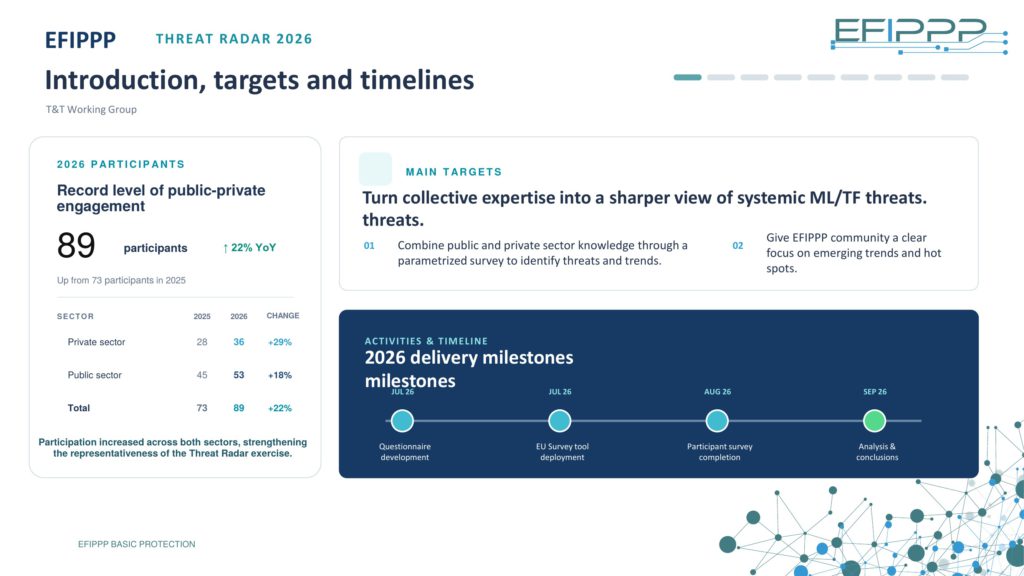
A total of 89 members responded, 53 of them public institutions, up from 73 respondents in 2025.