



By CARLO BOFFA, EU Correspondent
In early May, officials at the Bank of Greece desperately needed a powerful ally.
A few blocks from their offices, Greece’s capital markets authority, the HCMC, was poised to rubber-stamp Binance’s application for an EU crypto licence, with the support of the finance ministry keen to boost Athens’ appeal as a financial centre.
The central bank needed someone who could command international respect and explain that welcoming the world’s biggest crypto exchange, with its history of scandal, was not just a bad idea but a potentially dangerous one for a country the size of Greece.
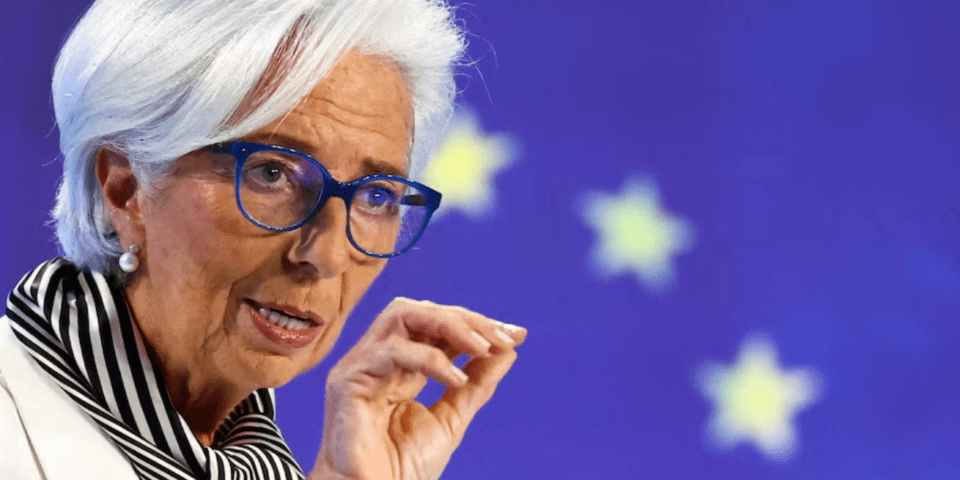
That person, the Bank of Greece decided, could only be Christine Lagarde.
The president of the European Central Bank has no formal role in deciding which exchange gets authorisation to operate in the EU. But the stature of her office, and a political career spanning three decades at the highest institutional level, give her opinions weight even in matters strictly outside her mandate.
Conveniently, Lagarde is known for her distrust of cryptocurrencies. She has made no secret of the fact that her son lost money investing in crypto against her advice.
“He ignored me royally, which is his privilege,” she told a town hall with students in Frankfurt in 2023. “And he lost almost all the money that he had invested.”
Even stablecoins — cryptoassets considered safer because their value is pegged to a regular currency, usually the US dollar — have failed to shift her view, as the bank is wary they could reduce the EU’s monetary sovereignty.
Lagarde’s involvement, first reported by the Wall Street Journal, succeeded in keeping Binance out of the EU for the time being. But the exchange has not stopped serving its millions of European customers, laying bare the gaps of the still-incomplete EU regulatory framework.
Singapore-on-Piraeus
Binance CEO Richard Teng announced in January that the company was seeking to move its European operations to Greece, where it had applied for a licence under the EU’s Markets in Crypto-Assets regulation (MiCA).
In Athens, the government of Kyriakos Mitsotakis was on a mission to make the city attractive to global financiers looking to cut their tax bill while enjoying the Greek lifestyle.
“This is a global war for talent. We need to make it easy for either Greek talent to return or for people who can live anywhere to choose to work here,” the premier said in a 2025 interview.
The government’s business-friendly stance began attracting family offices from Switzerland and the UK, as well as tech entrepreneurs from other EU countries. Hedge fund billionaire Chris Rokos is reportedly planning to move his tax residency from the UK to Athens. Binance saw an opening too.
But Binance’s bid soon set off alarm bells in EU regulatory circles. Some regulators knew the company well: it had pitched other EU capitals before, and its application was often judged incomplete. They were also wary of its methods, which they said leaned on currying favour with politicians over supervisory engagement.
The pattern was familiar. Binance made its approach promising millions of euros in investment and well-paid local jobs; politicians, eager to secure both, would back the exchange’s bid.
“Supervisors don’t like that, and supervisors with a strong backbone like it even less,” one person familiar with the matter said.
In Greece’s case, Binance projected its Athens expansion would generate around €200 million in tax revenue and create 100 high-paid jobs.
Greek newspaper Kathimerini reported that emissaries from the exchange met regularly with government officials at the finance ministry in the months before June, though a person familiar with the matter says most of the meetings were actually between the company and the HCMC.
Scrutiny
At the Bank of Greece, supervisors responsible for anti-money laundering oversight of local financial institutions were far less impressed.
Binance had also filed an application with them to issue stablecoins. But, in contrast with their peers at HCMC, they deemed it did not fulfill all provisions of the legislative and supervisory framework over compliance issues.
Binance pleaded guilty in November 2023 to violating US anti-money laundering laws, accepting a record $4.3 billion fine. CEO Changpeng Zhao, known as CZ, stepped down and served four months in prison before being pardoned by US President Donald Trump in October 2025. He remains Binance’s largest shareholder, though the company says he holds no operational role.
Recently, the company has been placed under investigation by US authorities for some trades executed on its platform that might have breached Iran sanctions.
After the 2023 settlement, the EU’s market and banking authorities, ESMA and the EBA, asked national authorities to review the impact of Binance’s operations in their own countries — a review that has not been reported before. Several flagged inadequate anti-money laundering controls and an opaque corporate structure.
The EBA also released an anonymised report, which AML Intelligence established makes reference to the findings, expressing similar concerns and describing questionable practices such as unauthorised operations and forum shopping.
Enter Madame la Présidente
When the EU introduced MiCA, requiring exchanges to obtain a licence in one EU countries from which they could operate across the bloc, regulators quickly became aware that firms were shopping around for the lightest-touch regime.
They believed Binance was doing exactly that. The HCMC, which issues crypto licences in Greece, had not yet granted a single one — raising doubts about its readiness to oversee a firm of Binance’s international reach.
The Bank of Greece sought international cooperation in the context of the stablecoin application, given Binance’s small customer base in the country. Some crypto-focused outlets reported talks between Greece and France to share oversight of the exchange, but these came to nothing.
With no other options left, the bank decided to ask the ECB for help.
The Bank of Greece said in a statement that governor Yannis Stournaras and Lagarde had no direct contact on the issue, and that the bank “simply applied the rules and did not ask or receive any advice or pressure by any other authority”. Asked to clarify to which of the two applications the statement referred to, the bank did not comment further.
The first contact between Lagarde and Greek authorities over Binance that AML Intelligence was able to establish came at an event organised by Greek media tycoon Theodoros “Theo” Kyriakou in mid May.
The Europe Gulf Forum, is a major international summit bringing together prime ministers, heads of state and other top policymakers for two days of talks at the luxury resort destination of Costa Navarino in the Peloponnese.
Among the dignitaries present were Mitsotakis and Pierrakakis, to whom Lagarde voiced her disapproval. “The ECB has been very adamant” that it did not want Binance to hold an EU licence, a person familiar with the matter said.
The ECB President, however, chose not to engage with the exchange directly, despite Binance falling within its PISA framework, the bank’s oversight standard for digital payments.
The ESMA meeting
After speaking with Lagarde, Mitsotakis is said to have taken a cautious stance. Binance could have its licence only if it was institutionally correct.
At the HCMC, though, officials were keen to press ahead with authorisation regardless of the central bank’s opposition.
Matters came to a head at a meeting of ESMA’s Digital Finance Standing Committee on 2 June.
A representative of the Greek capital markets authority told the committee that Binance’s application was “complete and compliant”. At the same meeting, a female representative of the Bank of Greece voiced her institution’s disapproval — a highly unusual step, given that the committee’s rules require institutions from the same country to coordinate their position beforehand.
The HCMC was then expected to approve the application at a board meeting on 18 June, before everything fell apart. Lagarde’s intervention had swayed the mood within the Greek government, which pressured the regulator to abandon its plans to grant Binance the authorisation.
With no options left, Binance withdrew both bids towards the end of June. The company said it remained committed to Europe and would seek a licence elsewhere, declining to name the country in question.
A close-knit community
For the EU’s supervisory community, the Binance case is also a reckoning. With little access to adequate tools, and with its regulatory architecture still incomplete, only a handful of EU countries would have the capacity to host a firm like Binance and capture the benefits of its local investment without also inheriting the reputational risks that come with it.
The community is about as close as Europe gets to a genuinely united bloc. The same officials might meet one week in Frankfurt at the general board of the EU’s anti-money laundering watchdog, AMLA, the next in Paris at ESMA, and the week after back in Frankfurt for the ECB’s supervisory board.
These forums let officials exchange views and information on matters where they have first-hand experience in their own country — and it was through this network that supervisors warned Greek authorities about Binance’s compliance issues.
But the EU lacks a genuine pan-European market supervisor. Responsibility stays with national authorities — who are left to clean up the mess when something goes wrong — while ESMA holds only a coordinating role. The ECB has been a vocal supporter of the European Commission’s proposal to entrust the oversight of all crypto exchanges to ESMA.
Supervising a crypto exchange of Binance’s size and reach is no small task, either: authorities need large enough teams and blockchain-analysis tools that are hard to source, expensive, and often controlled by American companies. Given the current geopolitical climate, regulators have discussed promoting European alternatives, but progress remains slow.
For Binance, little changed once the July deadline to obtain a MiCA licence passed, despite ESMA’s warnings to unlicensed firms. The exchange, along with peers such as HTX and MEXC, continued serving European customers through its Abu Dhabi entity, though it stopped onboarding new ones in the six countries where it operated directly.
With a global drive towards deregulation and crypto-friendly policies, the EU is swimming against the tide by maintaining a tough regulatory stance. But companies are finding ways around it that leave them in a regulatory grey area, and so far the bloc has looked powerless to stop them.
The ECB and ESMA declined to comment on this story. Binance did not respond to a request for comment.
A source from Greece’s finance ministry said Greek independent authorities act within a well defined regulatory framework. “The responsibilities are clear and the roles are entirely distinct. Independent authorities make their decisions in accordance with the institutional and regulatory framework, while the Government exercises its own responsibilities.”
A spokesperson for the HCMC said: “HCMC acts independently and is not subject to political or other influence or direction. Applications are assessed solely on the basis of applicable European and national legislation and the relevant licensing requirements. Had the application not been withdrawn, any decision on the application would have been taken solely on the basis of those applicable requirements and no other consideration.”