



By Arik Oslerne, CEO & Co-Founder of Steward
A single AI agent can now complete the work of 27 KYC analysts, according to benchmarking published by compliance technology firm Steward, which reprices one of the most expensive and least loved exercises in financial crime compliance.
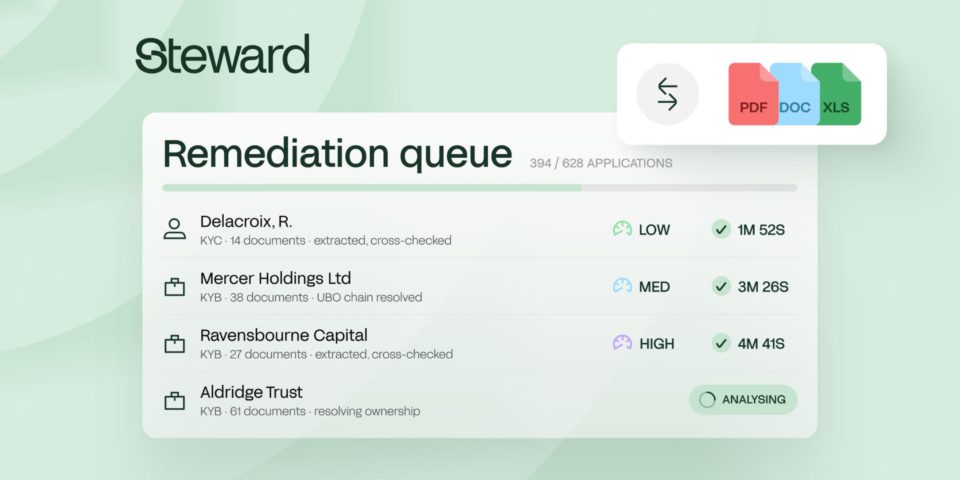
Steward this month released AI agents built specifically for KYC remediation. The company says the agents ingest customer documentation, extract and cross-check the underlying data, and produce a risk assessment in under two minutes for simple files and five minutes per file for complex cases. The same review, carried out manually, takes an analyst between 30 minutes and three hours on a good day.
The Rathbones warning
On 21 July, Rathbones Group told the market it would spend approximately £60m over two years on remediation following a skilled person review conducted after engagement with the Financial Conduct Authority (FCA).
The FTSE 250 wealth manager voluntarily paused contributions into general investment accounts for around 4,700 existing higher-risk clients, and stopped onboarding new clients requiring enhanced due diligence for up to a year. Taken together, those measures put close to £900m of annual gross inflows at risk.
Shares fell more than 18% in early trading. Rathbones lost close to a fifth of its market value without being penalised by the FCA. The cost was the remediation itself, and the commercial paralysis that came with it.
The industry has been pricing remediation as a compliance cost line. Rathbones showed it is a revenue event. When you cannot onboard a higher-risk client for twelve months because your files are not in order, a fine is almost a footnote.
Why the clock matters
The length of a remediation programme can be debilitating. Rathbones’ programme runs for two years. Every additional month of look-back is a month of foregone flows.
Historically the only lever available has been headcount, contract analysts, offshore delivery centres, or a consultancy engagement priced accordingly. Large-scale KYC remediation programmes routinely run into the hundreds of thousands of pounds, and for tier one institutions into the millions.
Remediation has been a byword for “it is time to change jobs”. You put good analysts in front of folders, emails and PDFs for eighteen months and ask them to find out how many skeletons are in the closet. Nobody in that room wants to be there, and the quality of work shows despite firms paying premium rates for it.
Extraction, reconciliation and completeness checking consume the bulk of an analyst’s time on any given file, and those are precisely the tasks that generative extraction and agentic workflows have become reliable at. The genuine risk decisions, in-depth narratives and investigations is where human expertise earns its cost.
A challenge to the delivery model
A significant portion of the anti-financial crime services industry is built on billable analyst hours. Firms deploy 30, 90 or several hundred contract specialists onto a client’s remediation programme and price the engagement on that basis. If per-file review time compresses by an order of magnitude, the economics of that model change materially.
Some providers are already moving. Advisory firms across the UK, US and Nordics have begun embedding automation into remediation delivery rather than resisting it, positioning throughput as a differentiator rather than a threat to revenue.
Every consultancy running a remediation practice is going to have the same conversation in the next twelve months. Should we defend the hours or the outcome? The firms that pick the outcome will take the market.
The regulatory backdrop
In the EU, the Anti-Money Laundering Authority’s rulebook takes effect in 2027, with group-wide framework obligations that will pull entities into scope which have never held a compliance function. In Australia, tranche two reforms brought lawyers, accountants and other professional services firms into the AML/CTF regime this month. In Canada, effectiveness reviews have taken on new weight following recent enforcement action against a major bank. In the US, the investment adviser AML rule extends CIP and programme obligations to the sector.
Each of those changes creates the same downstream problem at a different scale: a population of customer files assembled under one standard that now has to satisfy another.
Nobody builds a KYC book expecting to rebuild it. But every firm does, every few years, because the standard moves. The question is whether you rebuild it in two years with two hundred people, or in two months with agents and a small team of experts checking the hard cases.
The benchmarking
Steward’s figures are drawn from several hundred files rather than a full institutional book. The firm’s 27x figure is derived from an average of five minutes per application running continuously against a single analyst completing one remediation every 45 minutes across an eight-hour day.
You can find more information here: GetSteward.ai