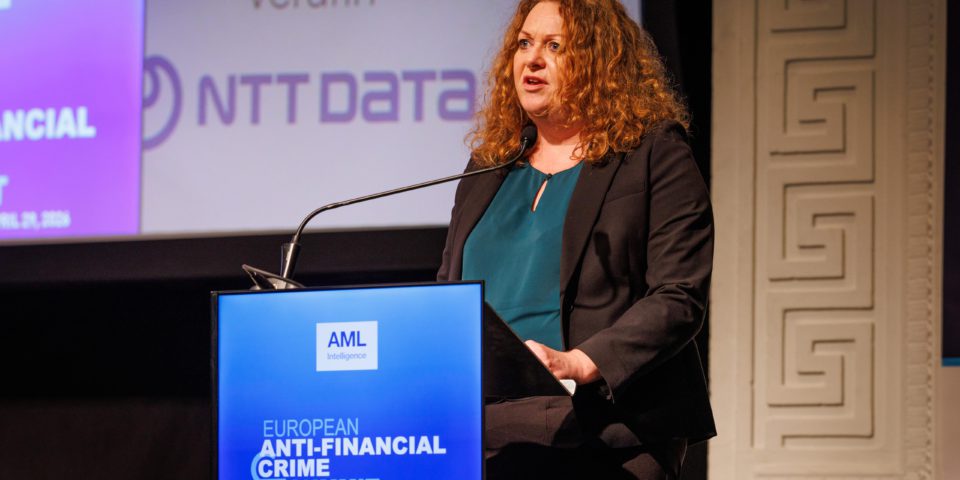
THE Central Bank of Ireland will launch a review examining how funds report suspicious transactions.
Speaking at the European Anti-Financial Crime Summit (EAFCS) 2026 in Dublin, Patricia Dunne, the regulator’s Director of Horizontal Supervision, warned that the sector carries a high financial crime risk.
Subscribe now to have unlimited access
With our membership subscription, you will have unlimited access to the AML Intelligence site, updated daily with the latest analysis, opinion, and breaking news across the sector, newsletter delivered twice per week, access to our Global Bank Fines & Penalties database, free access to Boardroom Series and more!
Update to UK Sanctions List: ISIL (Da’esh) and Al-Qaeda Regime
UK Government
Today, Friday 16 October, the UK Government has amended 2 individuals and 1 entity sanctioned under the ISIL (Da’esh) and Al-Qaeda Sanctions Regime. This reflects amendments made on 15 October by the UN Security Council Sanctions Committee pursuant to Resolutions 1267 (1999), 1989 (2011) and 2253 (2015).
Amended Individuals:
HKMA announces “ART” Framework to promote responsible A.I. adoption
HKMA
The Hong Kong Monetary Authority (HKMA) announced today the “ART” Framework to support the responsible adoption of artificial intelligence (A.I.) in the banking sector, fostering an A.I.-enabled banking ecosystem with Accountability, Resilience, and Trust.
A.I. systems are becoming more autonomous, with greater access to data, tools and workflows. With the aim of supporting banks in seizing the opportunities presented by A.I. while maintaining robust governance and operational resilience, key initiatives under the “ART” Framework include:
Issued the latest Supervisory Guidance for Responsible Adoption of Artificial Intelligence, drawing on insights from the second cohort of the Generative A.I. (GenA.I.) Sandbox1;
An A.I. training data sharing platform in collaboration with Hong Kong Cyberport Management Company Limited (Cyberport) and the University of Hong Kong, with data quality assurance as a core design principle; and
Further testing of agentic A.I. applications through the GenA.I. Sandbox++2 and an upcoming discussion paper on a proposed supervisory framework for agentic A.I. governance, exploring intent-anchored accountability, a registry of material A.I. agents, and effective intervention mechanisms.
Global drug plot foiled in joint investigation between AFP and Chilean police
Australia Federal Police
A joint investigation by the AFP and Chilean authorities has led to the arrest of four people for their alleged roles in a failed plot to import 23kg of cocaine into Australia.
Inquiries by the Policia de Investigaciones de Chile (PDI) uncovered alleged plans by an organised crime network to import cocaine into Australia via a commercial aircraft.
The PDI seized the cocaine, which has an estimated Australian street value of $17 million, and shared intelligence with AFP investigators.