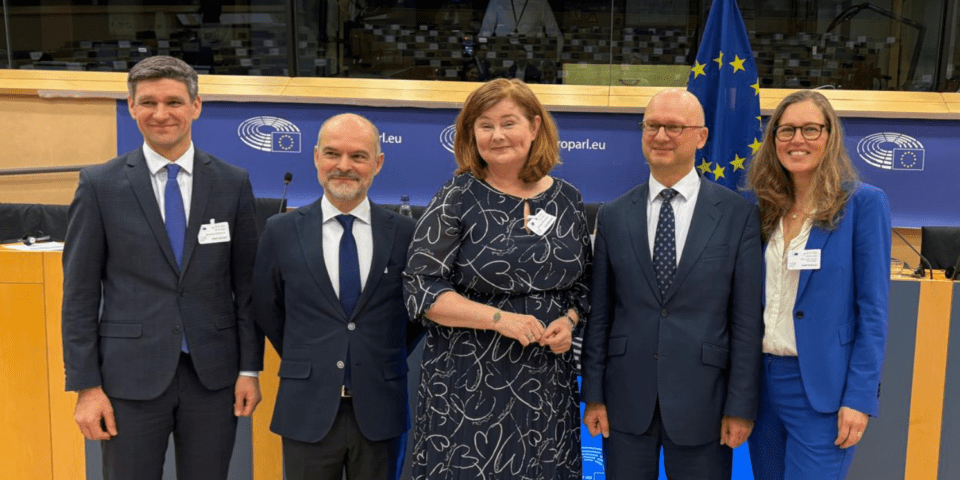
PARLIAMENT: The new members of the AMLA executive board. Pictured (right to left): Simonas Krepsta (Lithuania), Juan Manuel Vega Serrano (Spain). Derville Rowland (Ireland), Marcus Pleyer (Germany), Rikke-Louise Petersen (Denmark).
THE five permanent Executive Board members at the EU’s new AMLA watchdog are making their final pitch today to a top EU committee.
Speaking before the LIBE (justice) committee of the European Parliament, the five are expected to be formally ratified as members of the AMLA Executive Board later today.
Subscribe now to have unlimited access
With our membership subscription, you will have unlimited access to the AML Intelligence site, updated daily with the latest analysis, opinion, and breaking news across the sector, newsletter delivered twice per week, access to our Global Bank Fines & Penalties database, free access to Boardroom Series and more!
Today, as part of Operation Economic Outcast, the U.S. Department of the Treasury sanctioned Panama- and Greece-based law firm Karnakis and Karnakis, which has supported illicit Iranian shipping activity for years, indirectly aiding Tehran’s ability to generate revenue to fund its military, weapons, and nuclear programs. Throughout Operation Economic Outcast, Treasury has continued to coordinate with counterparts in Europe and around the world to sever the Iranian regime’s remaining economic lifelines. Treasury today also sanctioned Singapore- and UAE-based shipping agents that directly aid Iranian shadow fleet operations.
Bulgaria: Mayor of Petrich indicted for fraud involving cultural heritage museum
European Public Prosecutor's Office
(Luxembourg, 21 October 2026) – The European Public Prosecutor’s Office (EPPO) in Sofia (Bulgaria) has filed an indictment at the Sofia City Court against the mayor of Petrich, a municipality at the border with Greece, accused of fraud involving the reconstruction of a building to convert it into a cultural heritage museum under an EU-funded project.
At issue is a project to showcase the shared cultural heritage of Bulgaria and Greece, as part of the ‘Cultural Dipole in Cross-Border Area’ initiative, co-financed with €646 857,59 by the European Regional Development Fund (ERDF) under the 2014-2020 INTERREG V-A Greece-Bulgaria Cooperation Programme.
The UK and Singapore Hold 11th UK-Singapore Financial Dialogue, Deepening Cooperation on Digital Finance, Capital Markets, and Sustainable Finance
MAS HM Treasury
Singapore, 20 October 2026… The United Kingdom (UK) and Singapore held the 11th UK-Singapore Financial Dialogue in Singapore today. Reaffirming their strong and longstanding partnership, the discussions focused on advancing cooperation in digital finance and innovation, capital markets, sustainable finance, and regional and multilateral initiatives.