



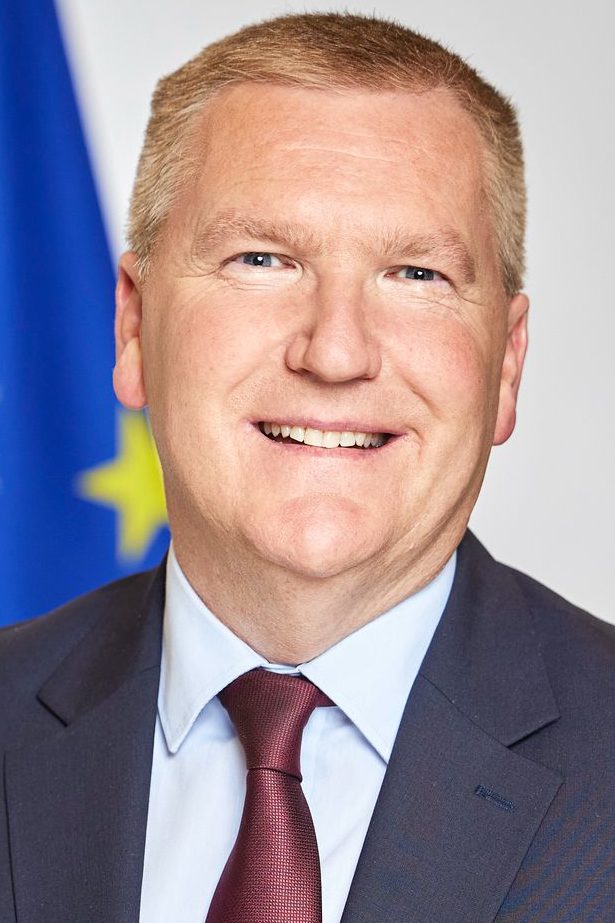
By Michael McGrath
European Commissioner for Democracy, Justice, the Rule of Law & Consumer Protection
WHEN combating serious cross-border crime, the weakest link is rarely a lack of law or enforcement; it is the gaps between systems. Criminal networks move money, data, and people across borders at speed. They exploit inconsistent procedures, delayed information sharing, and fragmented investigations and prosecutions. Too often, they are able to move faster than the authorities pursuing them.
This is why in June of this year, the European Commission proposed to strengthen Europol and Eurojust, the EU agencies that support Member States in tackling serious and organised cross-border crime – from police cooperation through to judicial cooperation.
Our objectives are practical and operational: to close the gaps between national law enforcement and judicial authorities and ensure they can investigate, coordinate and prosecute seamlessly across borders – from first investigation to final court case. Eurojust falls within the remit of my own portfolio, and I am determined to ensure it continues to carry out critical work and that criminals can no longer hide behind national borders.
The gaps that criminals exploit
An investigation starts with a lead, perhaps a suspicious transaction or an irregular pattern of assets being moved. Information about these transactions is held in several Member States. The criminal network moving them might be using digital infrastructure and intermediaries to cross borders quickly and quietly. By the time investigators have connected the different strands of evidence, the money may already have moved through multiple jurisdictions.
‘We will modernise how [Eurojust] is run by creating a new management board dedicated to running the Agency’
At the operational level, the challenge is not simply to gather more information. It is to connect information more quickly and directly, so that investigations can start early, and prosecutions can follow faster. This requires authorities that can connect the dots across agencies and borders with the same speed and agility that criminal networks exploit.
This is where Europol and Eurojust sit at the nexus between law enforcement and judicial cooperation. When engaged early and effectively, they help national authorities identify links across jurisdictions, anticipate emerging connections, and coordinate effective investigations that lead to robust prosecutions. Our proposals will enable both agencies to intervene earlier, coordinate more effectively and support Member States throughout the lifecycle of a cross-border case.
Eurojust: earlier judicial coordination and quicker connections
The law enforcement chain does not end with the arrest of a suspect. Cross-border cases are often won or lost in the judicial phase, not because the facts are unknown, but because the legal process begins too late, moves too slowly, or lacks effective coordination.
Eurojust’s role is to help judicial authorities coordinate complex cross-border investigations and prosecutions. The proposed revision of the Eurojust Regulation aims to make judicial cooperation faster, more operational, and more effective.
First, the proposal strengthens Eurojust in areas directly relevant to financial crime: improving the collaboration with asset recovery offices, collecting electronic evidence, freezing criminal assets, and cross-checking links between cases. The Agency will also better support Member States in tackling new offences such as gender-based violence and cybercrimes, which thrive online and increasingly span multiple jurisdictions.
Second, through governance that supports operational focus. We will modernise how the Agency is run by creating a new management board dedicated to running the Agency. This will free up the National Members to focus entirely on investigating cross-border crime. Requiring those National Members to be prosecutors or judges, will also ensure they possess the judicial authority and operational experience needed to drive investigations forward more effectively.
Third, under the proposed new mandate, Eurojust will be able to act more on its own initiative to identify links between cases, anticipate the need for coordination, and help resolve jurisdiction issues. This earlier engagement will lead to quicker coordination and more coherent investigations. Closer, systematic information exchange with Europol and the European Public Prosecutor’s Office will further accelerate the identification of linked cases and avoid duplication of effort.
In 2025, Eurojust supported 14,000 cross-border criminal investigations and more than 400 Joint Investigation Teams, leading to €1.2 billion in criminal assets being frozen and €31.4 billion in illicit drugs being seized’
Finally, through strong international engagement. The proposals also aim to strengthen Eurojust’s ability to cooperate more closely with countries outside the EU and international partners, because dismantling global criminal networks requires cross-border investigations beyond the Union’s borders.
The scale of Eurojust’s work also illustrates why modernisation matters. In 2025, Eurojust supported 14,000 cross-border criminal investigations and more than 400 Joint Investigation Teams, leading to €1.2 billion in criminal assets being frozen and €31.4 billion in illicit drugs being seized. These figures demonstrate the Agency’s operational importance, but also the increasing scale and complexity of the criminal threats Europe faces.
Closing the gaps is how we protect Europe
Criminals exploit the gaps between jurisdictions, between agencies, and between the investigative and judicial phases of a case. Europe’s response must be to close those gaps by making cooperation faster, more integrated and more operational.
As criminal threats evolve, the EU judicial landscape must evolve alongside them. By strengthening Europol and Eurojust, we are equipping Member States with stronger operational support at every stage of the criminal justice process- from intelligence gathering and investigation to prosecution and asset recovery. In doing so, we will help ensure that criminals can no longer exploit Europe’s borders faster than Europe’s authorities can protect them.