



By PAUL O’DONOGHUE, Senior Correspondent
AGENTIC AI will transform how financial institutions tackle financial crime, allowing them to improve operations while lowering costs, according to the head of NTT DATA .
Neil Kelly, managing director of the business, said the technology will allow workers to focus more quickly on genuine threats.
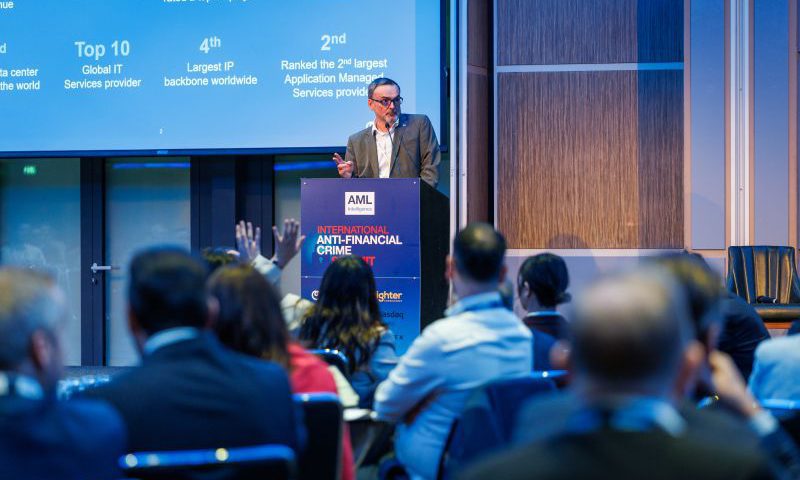
“We all know many financial institutions are weighed down with volume, sheer volume. All the alerts you have to deal with, all the false positives,” he said during a speech at the ‘International Anti-Financial Crime Summit’ (IAFCS) 2025.
““[With agentic AI] compliance costs drop, decision speed improves, and the risk coverage actually expands.”
He added: “Instead of waiting for human instruction, the agents can totally monitor triage and even close out the risk cases.
“They’re continually learning from analyst feedback, improving the accuracy over time. And we’ve seen early adopters of this capability, the ability to dramatically reduce false positives.”
Agentic AI
Agentic AI refers to AI systems, or ‘agents’, which can make decisions with minimal human oversight.
Unlike traditional AI, which requires step-by-step guidance, agentic AI can operate independently.
Kelly also said that the technology will greatly aid financial institutions in dealing with money laundering risks. He said this could work by cutting out large numbers of ‘low-value’ alerts which can overwhelm compliance teams
“For example, when an AI agent might review a series of small cross border payments that are known to fit low risk patterns,” he said.
“Instead of escalating every one of those to a human, it [the AI agent] makes the decision, documents the rationale, and moves on. 24/7.”
He added that human oversight will still be crucial, to deal with threats identified by agentic AI.
“The system flags genuine suspicious patterns,” he said. “[It will] spot the emergent behaviors that may signal layering or sanctions evasion. The transactions that require deeper human investigation get preferred.
“This results in outcomes where the human analysts are focused on real time threats. Not just repetitive noise. AI essentially allows them to do more with less. More insight, less manual effort, more vigilance, less fatigue.”