

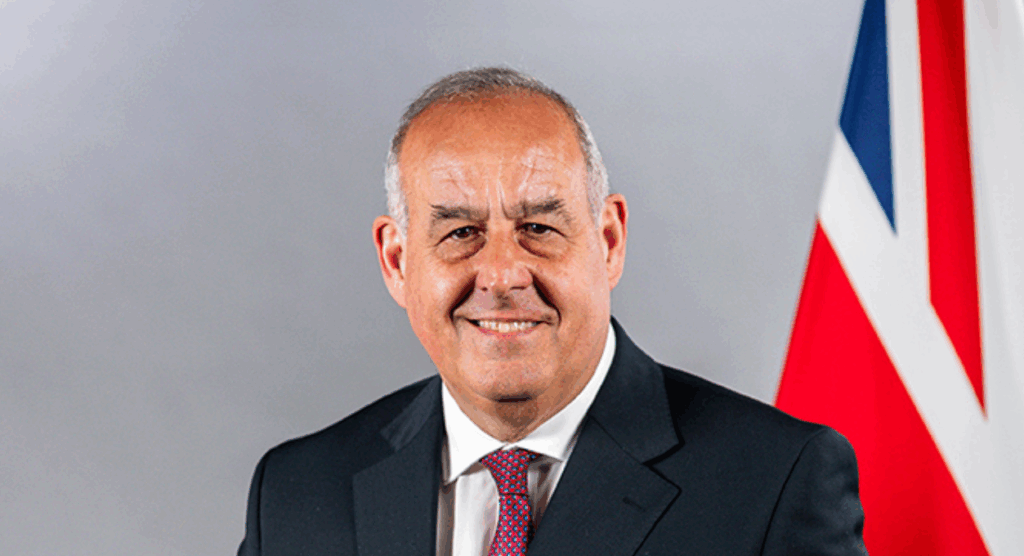
David Hanson
Minister of State at the UK Home Office
- David Hanson, Minister of State at the UK Home Office, delivered the following keynote speech at the 2026 Global Fraud Summit in Vienna
WELCOME to this conference in Vienna.
This threat of fraud has bedevilled every generation that has ever existed, from ancient civilizations to the Ponzi schemes of the last century, history is littered with people who want to use fraud to damage our individuals in our society and our businesses.
There are always those who are driven by greed, and there are always those who will stoop to deception. But while this aim never changes, we know now that new developments bring new tricks, and today, as my colleagues have mentioned, is more different than ever before in our society.
Today, in the digital age, the tools and tactics of fraud have evolved beyond anything the scammers and swindlers of the past could ever have imagined, let alone execute.
What once required proximity, being close to the person you are defrauding, now can be done from any part of the world to any individual or business, anywhere in the world.
Fraud is international, and the results are devastating.
UK fraud impact
In my country, the United Kingdom, alone, fraud accounts for 44% of all of our crime, damaging individuals, damaging businesses, damaging our economy, and stopping our ability to grow our economy and trade with our partners. That resource, as mentioned by colleagues from Interpol, is about actually being drawn from the United Kingdom and recycled in drugs, in people trafficking and in other forms of criminal activity.
Behind every statistic lies profound human suffering, individuals defrauded of their hard-earned savings, businesses crippled by ruinous losses. Victims left to count the cost of those responsible, with our economy stalled as a result.
Now, for the UK’s part, we have put in place a strategy which I was pleased to launch only a week ago today in London, the contents of which you’ll hear more about in the Summit as we go on.
But our strategy depends on 6 or 7 really key issues: data sharing, understanding what the data is; international co-operation, working with you and partners to deliver better outcomes; public awareness of fraud across the world at large and across our communities of what the scammers are up to and how the scammers operate; greater support for victims of that journey, so they are registered and we know what their victim journey is; AI, which 4, 5, 6 years ago was not thought of, what’s it going to look like in 4, 5, 6 years’ time, in relation to the scammers who, unlike governments, are unregulated, can do what they please, and we need to be aware of those challenges.
Hitting profits
And let’s look at what we can do to tackle their assets, to hit their profits and to bring them to justice.
So I’m particularly pleased today that we have political leadership in this room, not just from myself in the United Kingdom, but from countries across the world who are saying no to scammers and no to this action.
The prevalence of fraud today speaks to a truth we must all confront, that criminal gangs do not respect borders, whether in fraud, people smuggling or cybercrime, and the transnational nature of those threats mean that no country – no matter how big or how small – can tackle this challenge alone.
In an online age, not even the most capable, sophisticated government or agency has all the answers, which is why I’m pleased we’re here today, and occasions such as this Summit can really be never more vital.
Over the next 2 days, we have the chance to engage in free and frank discussions about the challenges we face, whether from our respective countries or as a collective.
We can air the insights and perspectives that we have about our common goal for the future.
We can, I hope, secure concrete actions to drive down fraud and make our citizens safer.
Actions
Actions such as the global public private partnership to operationalise the United Nations Framework. This partnership, which my country, the United Kingdom, has spearheaded developing, creates a real shared way of working between governments and industry, one that will make prevention and disruption faster, more consistent and more effective, with stronger safeguards to stop fraud at source, with simple, accessible reporting mechanisms and with swifter identification of emerging patterns and repeat offenders.
And above all, it shows our commitment to work with anyone, and I mean anyone, to fight this crime.
All of this is needed, but I suggest to us today, colleagues, that we must go further.
We must include removing unnecessary barriers to lawful information sharing, so that we collectively, across nations, can share information about what bad actors are doing. And we need to look at real time harm, not slow-motion co-operation.
We need to have speed and agility as the threat demands.
And again, I say to us all today, co-operation, international co-operation, is the only way forward.
Cooperation
The United Kingdom is particularly proud to stand alongside Australia, France, Italy, the United States, New Zealand, Canada, Singapore, Japan, South Korea, and also our private sector partners in Google, Match, Meta, Amazon, Virgin Media and the International Banking Federation in our public-private UK partnership.
Because as crucial as prevention is, it is only one part of the solution.
We know that across the world, the same networks that are perpetrating fraud on the people that we represent in the United Kingdom are also engaged in human trafficking, exploitation and money laundering, and no government should be able to tolerate that level of crime.
I’m therefore pleased to announce that the UK government will support the new Interpol led Global Task Force on scam centres.
Task Force
We will take the fight to these international scale criminal operations head on.
We will try to break, with Interpol support, the vicious cycle that threatens the safety and stability of our nations, and as government and law enforcement agencies step up, I have to say, so must all the platforms and the services that criminals exploit.
I’m pleased today that it’s not just governments, it’s not just law enforcement agencies, but it’s also the platforms by which people access fraud that are here today. We have several major technology companies represented, and that sends a shared signal, I believe, to the world at large, that this is a shared priority for government, for law enforcement, and also for the platforms that operate.
People need to have trust and confidence in their expenditure on platforms.
It’s a shared interest for the future.
Optimism
So, we have an opportunity in these next few days to continue this long battle against fraud.
But I want to end on a note of defiance and optimism.
Just because something keeps happening does not mean we accept it as our fate.
The steps we are taking now are making it more difficult for criminals to operate. Criminals will be watching this summit and see government, law enforcement and private sector working together.
This is a unique opportunity to build a response equal to the scale of the threat, to mount a stronger effort than ever before, to take the fight to fraudsters, to help free our societies and our systems from their diabolical grip.
That’s a formidable task.
We are never going to stop all fraud, but we have a duty, a duty as society, government, law enforcement and as platforms to make sure that we take this formidable task on.
This is one of the defining security issues of our age.
We are called upon to defend our values, uphold our security and to make sure that technology works for the people, not the fraudsters.
For the sake of our citizens, our businesses, our institutions. We have a duty, colleagues, to succeed.
And if we act with that shared purpose, if we draw on the strength of the nations that are present here today, if we draw on the strength of law enforcement that is here today, I believe we can and we will prevail.