




By PAUL O’DONOGHUE, Senior Correspondent
AI is set to overhaul the way companies approach compliance. The technology will reduce false positives, streamline customer onboarding and cut case resolution time.
However, companies still face some barriers to adaptation – with poor data quality being perhaps the biggest one.
These were the trends which stood out in the FinCrime Frontier 2025–26 Report. Produced by SymphonyAI and AML Intelligence, the survey is a comprehensive overview of the most important trends in the world of compliance and AML. It is available to read [HERE].
The study polled 250 senior financial crime and compliance professionals across banking, insurance, and fintech sectors worldwide.
It highlighted how AI adaptation has emerged as perhaps the single most important issue in the world of compliance.
Some 80% of respondents plan to innovate with AI in the coming 12 – 18 months. However, many firms are still in the ‘early exploration phase’. They are experimenting with data, governance, and small-scale proof-of-concept projects.
A major problem for many of these businesses is confidence in data quality.
The survey asked about the level of confidence in ‘data quality and reliability for AI-related AML processes’.
A majority of respondents – 58% – admit to gaps, inconsistencies, or major challenges.
Just 11% feel very confident that their data is clean, traceable, and governed.
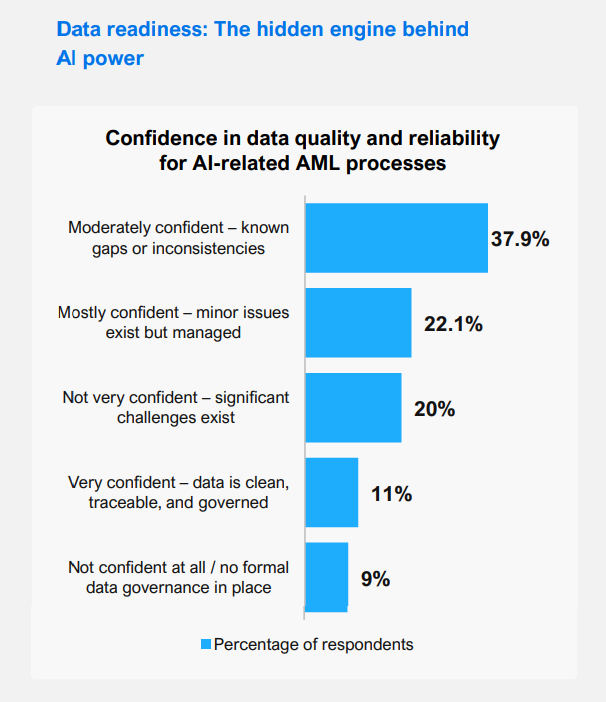
These findings make clear that data maturity is fundamental to AI maturity.
Data modernization
To fully unlock AI’s compliance benefits, organizations need to invest in data modernization.
High-quality data allows companies to confidently scale AI technology in their compliance and AML operations – with all the benefits that brings.
A clear example is cutting down on false positive alerts.
High false positive rates remain one of the most persistent obstacles in AML operations. ‘Fincrime Frontier’ found that more than 70% of institutions report rates above 25%. Nearly a third face levels exceeding 75% – a costly drain on investigative resources.
AI helps businesses to cut down on this, by allowing firms to manage large alert volumes more efficiently, and reduce human error.
This is reflected in how survey respondents ranked ‘Reducing the false positive rate’ as the top indicator of AI model precision.
Return on investment for AI in compliance
The potential benefits are also shown by the fact that the majority of those polled expect to see a ROI (return on investment) from AI-driven compliance programs within 12 to 24 months.
However, we then come back to data – or the lack of it.
The vast majority of firms do not know if they receive value for money on new investments.
A staggering 72% of ‘Fincrime Frontier’ respondents have not conducted a formal ROI assessment on compliance spending. Only 28% have done so, typically as part of broader digital transformation programs.
It all comes back to data.
AI is crucial for modernizing compliance systems. ‘Fincrime Frontier’ clearly shows that the overwhelming majority of companies in compliance and AML plan to adopt the technology. And they expect it will be transformative – improving operations and quickly generating an ROI.
The missing piece of the puzzle is good data, to ensure this all happens as planned.