

By Matei Rosca
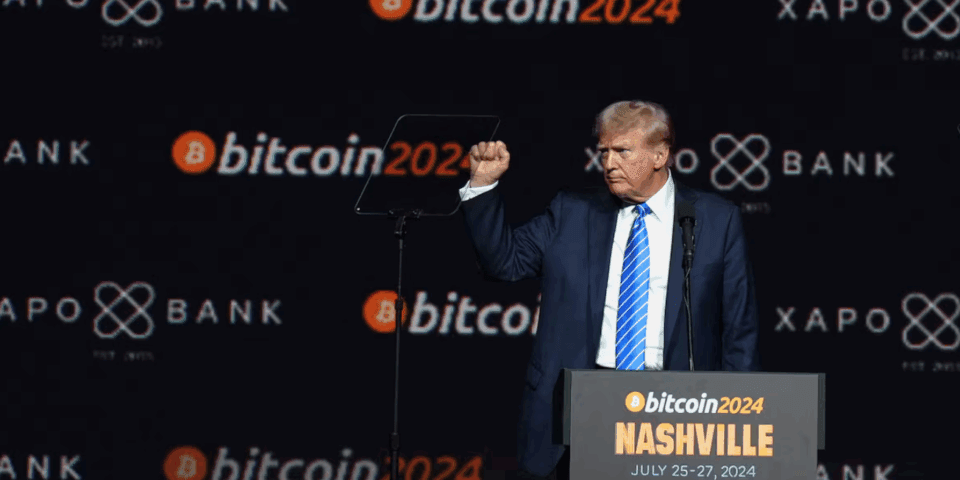
US President Donald Trump’s active courting of the global cryptocurrency industry, and indeed, through the Trump brand, active participation in it, has raised eyebrows among finance watchers.
Analyzing Trump’s, and Scott Bessent’s, approach to monetary and fiscal policy in conjunction with their attitude to cryptocurrency suggests that the administration in Washington may be following a complex strategy to hugely boost demand for US dollars and Treasuries, consolidating both America’s hegemony as a reserve currency and its borrowing capacity.
For short, the calculation seems to be that the more anyone uses stablecoins, the more money the US government is able to borrow and spend.
By dropping prosecutions and future investigations into crypto, especially for accessory crimes such as money laundering and enablement of fraud, the White House is inviting tens of billions of dollars into its economy – much of which may well be dirty.
The logical result of this influx will be that a larger proportion of Treasury notes issuance will be absorbed by the cryptocurrency and stablecoin industries, which require real-world assets for their own credibility.
Tether impact
The mechanics of it are simple, and circular. Stablecoins such as Tether are typically backed 1:1 by US dollars, and to support this peg Tether buys large amounts of US Treasuries. Some estimates are that in a few years Tether may approach US strategic rivals such as China in their holdings of US Treasuries. This could help Washington with the threat that Beijing could dump US debt on markets to cause a crisis in the American economy. Surely, a welcome bonus from a Western perspective.
Tether is also not the only stablecoin to buy dollars, but it is the most powerful, and, notably, it has a known arrangement with the Federal Bureau of Investigation to provide it with client information upon request.
That gives the US government a measure of control over Tether’s client activity, although it also is allegedly used by the likes of drug cartels to launder money. When questioned, Tether always insists that it follows strong anti-money laundering procedures and “proactively” chases down illegal activity.
Treasuries
The added demand for Treasuries increases their price, and in government debt the price is inversely proportional to the yield (the yield is the relation between the nominal rate of interest and the market price). The lower the yield, the better off the government’s finances are, and the more it can spend. In effect, US officials may be tolerating illicit finance moving through crypto – once it is still being used to buy Treasuries.
In fairness, the dirty money aspect does not seem to be a deliberate choice. But merely a compromise resulting from the basic fact that it is extremely difficult, if not impossible, to reliably detect dirty money in cryptocurrency, especially if it has been laundered professionally.
Trump and Bessent want to support cryptocurrency as an industry of the future, which also has positive strategic implications for the US, and seem happy to accept the risks that come with this wager.
Indeed, the landmark GENIUS Act passed by Congress in July, has provisions for sanctions and anti-money laundering compliance for stablecoins that theoretically put them under the same standards as any traditional bank accounts. Whether the technical capability to do this exists or not depends on who you ask. But even where this ability exists, it would be logical to expect a period of disruption when international flows of illicit funds will significantly tick up, as enforcement and tracking catch up with the new system.
The idea may yet work.
‘Big Beautiful Bill’
Take Trump’s One Big Beautiful Bill that has just passed Congress. Although expected to add some $3.7 trillion to the already record-level of US government debt, yields have only slightly moved up. Compare and contrast this to the UK, where the failure of a relatively minor attempt to tweak welfare spending caused yields to jump, triggering late-night market-calming statements by the Prime Minister.
If this vision of the future pans out, the road to MAGA will be paved with roadkill consisting of anti-financial crime professionals, who are currently paid handsomely to keep dirty money at bay – admittedly with mixed results.
Having a new parallel financial system with fewer if any checks for dirty money, will mean fewer suspicious transactions passing through the regulated banking sector as it currently stands. But the amount of dirty money in the economy is liable to substantially increase.
What rational crook would risk getting caught by a bank when his dirty money can more easily be funneled into crypto?
Future of AML enforcement
Granted, the crook will still have to provide a measure of artifice to justify the cash, but that is nowhere near as difficult as bypassing traditional banking requirements. Therefore banks are likely over the coming years to cut down on compliance spending, as the data will show a decrease in red flags.
Where does this leave all the anti-fraud specialists, compliance professionals and adjacent investigative journalists and researchers such as myself?
I suspect we are going to have to go back to the drawing board, create new systems fit for the crypto world, and re-learn the basics of shoe-leather reporting and human intelligence gathering. This is what I am setting out to do having been named as a McGraw Fellow for the Spring 2025 cohort at City University New York, to write an investigation into money laundering and organized crime in crypto markets. More details [HERE].
- Matei Rosca is a journalist who specializes in international politics, economic crime, and investigations. He runs the multimedia news agency reporter.london.